
All Things RE: Development, Issue 001
RE: Building the Case
Welcome to All Things RE: Development — a blog on what's changing in permitting and commercial construction, and what's still getting worked out underneath the headlines. The name is a two-way pun: half of this is about development, and half is about everything that lives in an email's RE: line — the redlines, the re-reviews, the plans still in progress. Each issue breaks down a policy or program change, then shows how it plays out on a real project.
"RE: Building the Case" is also the name for the recurring case study segment — the part of each issue where we set the policy or program change against a real project we're working on, and build the case for what it does or doesn't hold up to in practice. First up: Los Angeles's new self-certification option for commercial tenant improvements.
RE: The Announcement
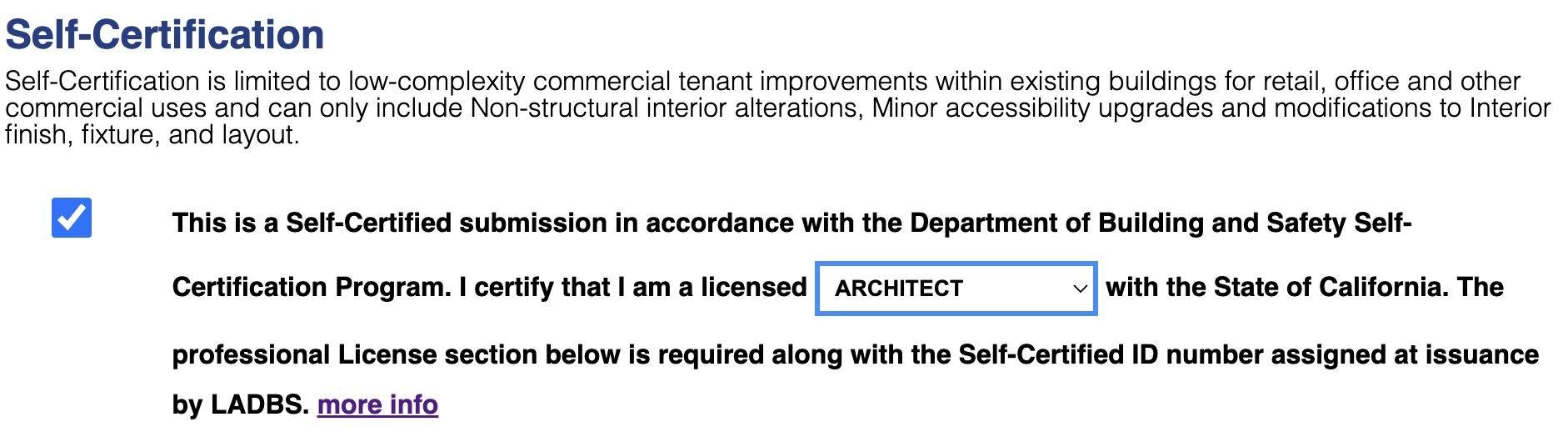
LADBS's Commercial TI Self-Certification program is now live on ePlan. In short: it applies self-certification to commercial tenant improvements citywide, but only on a limited basis — low-complexity, non-structural scopes, no change of use, stamped by a Self-Certified Professional instead of routed through a LADBS plan checker. Full program details are on LADBS's site.
It's real progress, and it's also early. As of this writing, the Self-Certification roster doesn't yet show registered commercial architects certified under the program, and intake staff still exercise discretion over which project scopes actually get routed through. "Self-certified" doesn't mean "self-service" yet — the infrastructure is being built in public, in real time.
Where Self-Certification Fits Nationally
LA isn't inventing something new here. It's one point on a spectrum of plan review models jurisdictions across the country have been running for years:
In-house review is still the default everywhere — plans go to a jurisdiction's own plan check staff, reviewed in the order they're received, subject to that reviewer's interpretation.
Third-party review lets applicants pay a certified outside reviewer to check plans in lieu of (or alongside) city staff. Closer to home, Costa Mesa offers accelerated plan check through an outside consultant on request, and the model is standard practice across much of Texas, Florida, and California for jurisdictions trying to clear backlogs.
AI-assisted and automated review is the newest layer. Honolulu's CivCheck platform cut average permit decision time from 73 days to 32.5 days in its first full quarter. Austin adopted AI-assisted review for residential plans in 2024. Seattle ordered an AI pilot across all development applications in 2025, with full rollout targeted for 2026.
Self-certification goes furthest: instead of a third party or an algorithm checking the work, a licensed professional checks their own and takes on the liability for being right.
The Case for Self-Certification (and the Case for Caution)
Self-certification isn't a new idea, and that's exactly why LA's version deserves scrutiny: there's precedent, and that precedent shows what guardrails matter — and how easily a program can end up without them.
New York City has run a Professional Certification program since 1995. The DOB's program page is worth a read for the distinction it draws: only a Registered Design Professional — a New York State licensed architect or PE — can certify a filing. A registered filing representative can submit documents and represent the project in front of the Department, but cannot certify code compliance on the RDP's behalf. The stamp, and the liability behind it, stays with the licensed professional. DOB also audits a minimum of 20% of self-certified filings after the fact.
Chicago draws a similar line. The city's Self-Certification Permit Program page makes clear that being the "applicant of record" or "project lead" on a permit is a project role — it doesn't, by itself, authorize self-certification. Only someone individually enrolled as a Self-Certified Professional can invoke it, and that status has to be earned: an Illinois architecture or structural engineering license held at least three years, a Department-run training course, and proof of liability insurance at $500,000 per claim / $1,000,000 aggregate.
But it’s important to note that not every jurisdiction that's tried this has kept it running. The County of San Diego's Self-Certification Program still lists commercial TI as an eligible project type, but unlike its other categories (grading, landscaping, private roads), the county's own program page currently shows no published list of approved commercial TI professionals — while the other lists are actively maintained. See the county's program page. In recent conversations with PDS, staff either couldn't provide information on the commercial TI track or, in some cases, weren't aware the option existed. That's a program stalling out quietly, with no public notice, rather than a program that's been formally shut down.
The pattern across the jurisdictions that have made this work is the same: self-certification isn't a waiver of scrutiny, it's a relocation of it — from before the permit is issued to a licensing, training, and audit structure around the professional issuing it, with a clear line between who can certify and who can merely file. That's the model LA needs to land on, and it's exactly the piece still being worked out. Get it right, and self-certification is a genuine advancement in how building departments operate. Leave the roster and audit structure unfinished, and it risks ending up where San Diego's commercial TI track is today.
RE: Building the Case — Banking on A Smooth Review
Here's where this stops being theoretical. We're currently working a project that shows exactly why this program matters — and why it isn't ready yet.
RE: The Project
The scope: a tenant improvement for an existing bank branch, remodeling in place, in a corner commercial unit of a strip mall in the City of LA. Same tenant, same footprint, no change of use, no change of occupancy. The work reflects a broader shift in retail banking — as more transactions move online, banks are reworking branches away from the standard teller-line-and-lobby layout toward space built for customer education and advisory conversations. The footprint isn't growing or changing use. What happens inside it is.
RE: The Problem
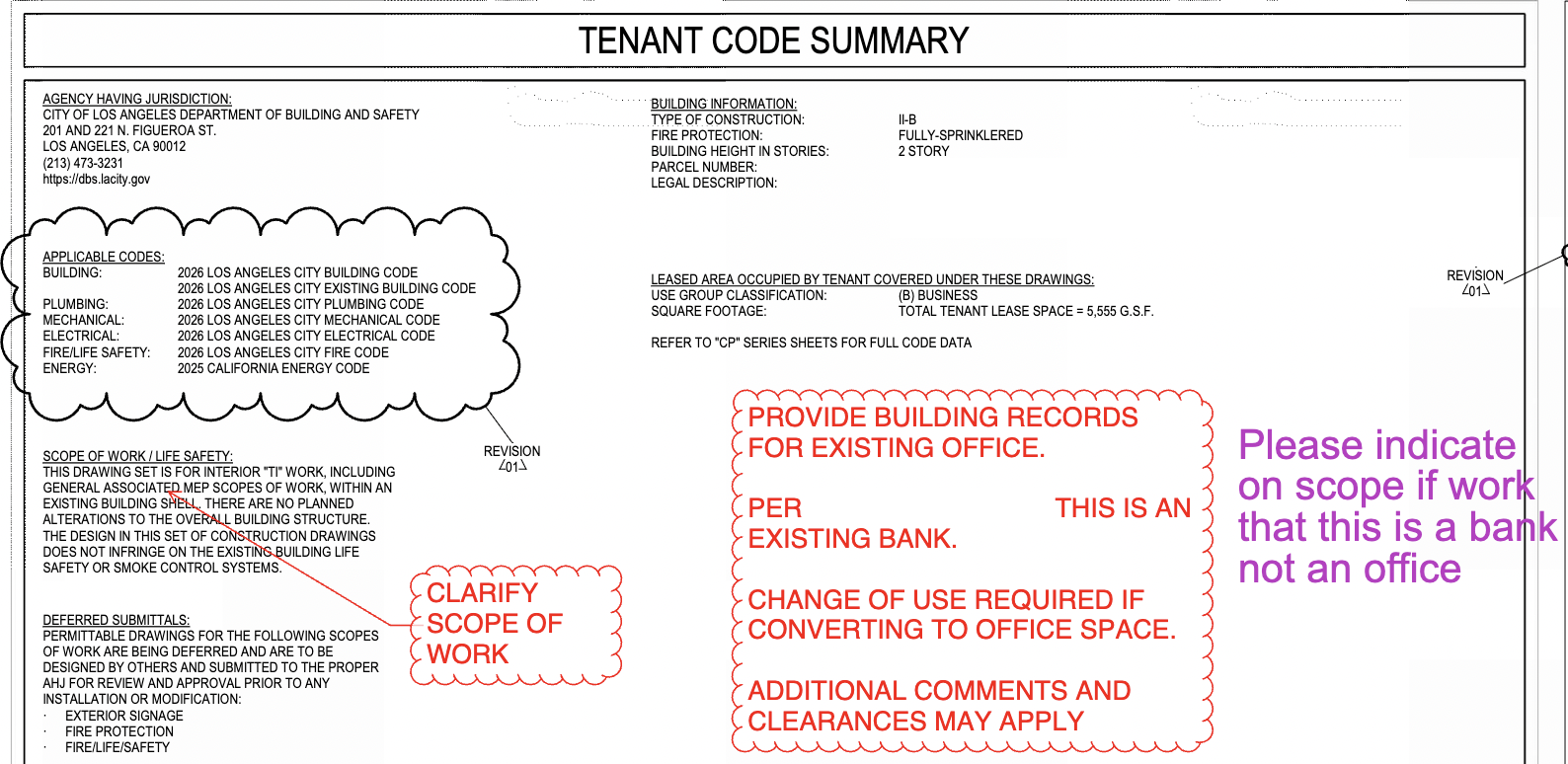
Applicants don't get to choose who reviews their plans. Whoever is assigned interprets the scope and the code implications at their own discretion — and that discretion is where this project stalled. A straightforward interior remodel, limited entirely to partitions and doors inside the existing tenant space with no change to the tenant's leased area, got flagged as a potential change of use. That triggered additional comment rounds and re-review cycles to walk back a classification the project never actually proposed.
Make it stand out
RE: What Self-Certification Would Have Changed
A plan check that should have taken two to four weeks stretched to roughly three months. That's not just a scheduling problem — it's a cost with a real number attached, on both the development and the tenant side.On the development/permitting side, RAND estimates California could cut total project costs by as much as 8.2% if permitting timelines matched faster-moving states like Texas (RAND Corporation) — that study looked at multifamily housing, not commercial TI, but the underlying mechanic (delay compounds cost) holds across project types.On the tenant side, the more direct number is what a signed lease already puts at risk when a space can't open on schedule. Publicly filed commercial leases show landlords agreeing to pay tenants liquidated damages of $2,500 per day for the first 15 days of a delayed delivery, stepping up to $5,000 per day after that (Law Insider) — real numbers negotiated into real leases as compensation for exactly this kind of holdup. A bank managing a multi-branch redesign rollout is carrying that same exposure, times every branch behind this one in the pipeline.
This is precisely the kind of project self-certification is built for: non-structural, no change of use, low complexity, reviewed and certified by a licensed professional staking their own license on their read of the code — instead of waiting for one reviewer's interpretation to work through multiple comment cycles. Self-certifying the plan check doesn't remove the rest of the process — inspections still happen in the field, and Planning, Fire, and any other department with jurisdiction over the scope still weigh in exactly as before. What it removes is the single point of discretion that turned a routine interior remodel into a three-month detour.
RE: What This Means for You
Self-certification is not a box you check. Even once LA's program matures, using it well still requires real strategy up front: confirming a project actually qualifies (scope, occupancy, structural elements, whether a change-of-use read is even a risk), knowing what's excluded, and understanding that Planning, Fire, and other departments with jurisdiction don't go away just because plan check does. Getting the qualification call wrong costs more than the plan check delay it was supposed to avoid.
Worth being explicit here: in NYC and Chicago, the authority to self-certify belongs solely to the licensed RDP or SCP who stamps the plans. A filing representative or permit expediter — us included — can't invoke it on anyone's behalf. California doesn't currently draw that line the same way; the state has no license or registration requirement for who can apply for a permit at all. That's worth watching as LA's program matures — a defined line between who can file and who can certify is exactly the kind of safeguard NYC and Chicago built in, and it's one LA may want to consider if this program scales beyond its current limited scope.
Either way, self-certification doesn't make the expediter's role obsolete; it changes what the role is. It's everything in the sections above: reading a scope correctly before it's submitted, knowing what actually qualifies versus what only looks like it does, and keeping Planning, Fire, and every other department that still has jurisdiction moving in parallel. The certification is the licensed professional's call. Whether a project is set up to use it well is a separate job, and it's still one worth doing carefully.
That's the barrier to entry most people don't see until they're already in it. If you're weighing whether a project like this one qualifies — or want a second opinion before you bet a timeline on it — that's a conversation worth having early, not after the first comment letter comes back. Reach out and we'll walk through it with you.
We'll keep watching how LA's program fills in, and keep reporting back from the field.
